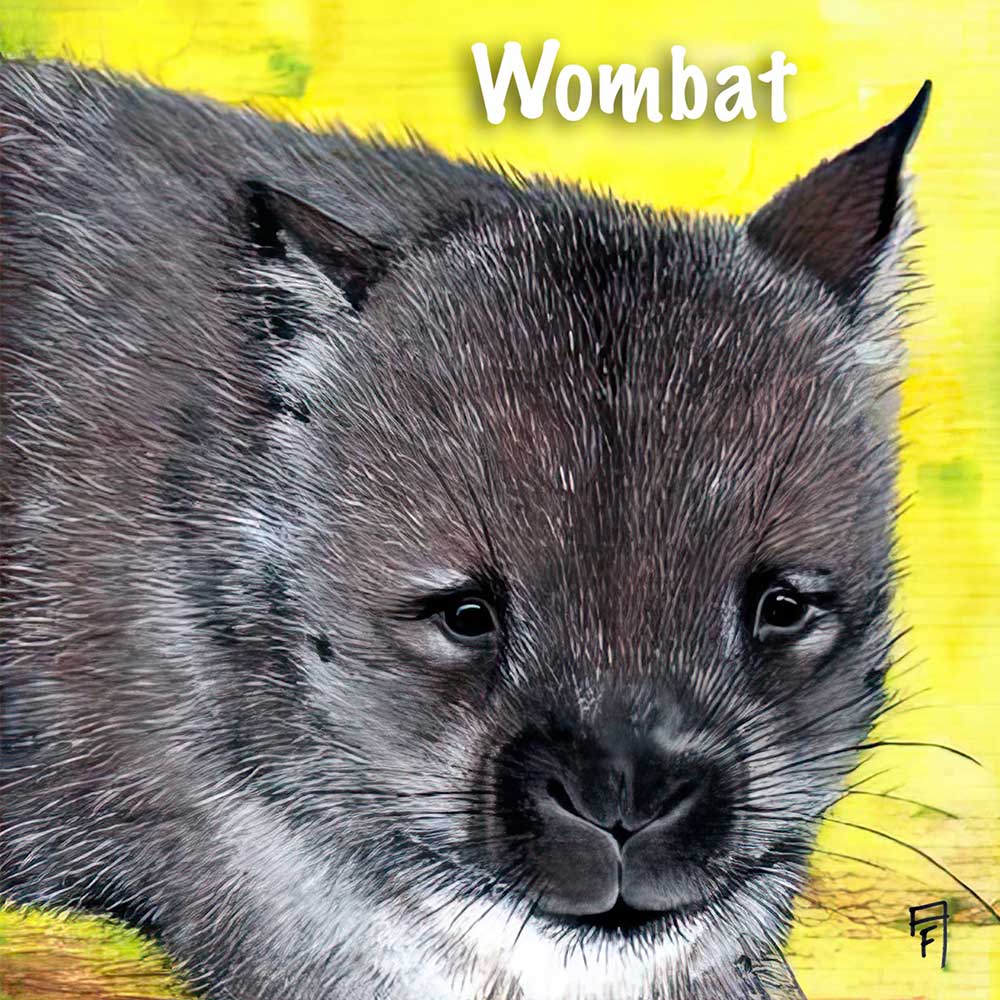

- largest marsupial in Tasmania, and the second largest in the world
- adult males can reach over 60 kg and stand 2 metres tall
- their colour varies from light brownish grey in males, to grey in females
- they have thick tails and large ears
- they make clucking sounds between themselves and give a guttural cough when alarmed.
- 68x68mm Square full colour printed magnet. 'TASMANIAN FORESTER KANGAROO'. 100% Tasmanian Made. (c) Annie Fitz - Art Magnet Range.Forester KangarooThe Forester kangaroo (Macropus giganteus)
- 68x68mm Square full colour printed magnet. 'Tasmanian Whiteback Magpie'. 100% Tasmanian Made. (c) Annie Fitz - Art Magnet Range.Tasmanian Magpies do not swoop at people. The Tasmanian magpies seem to be much more chilled than the mainland relatives. We don't know why it is that the Tasmanian magpies don't swoop and don't attack, but it's just one of these things that it's a very conspicuous difference.Tasmanian Whiteback Magpies are the subspecies of the Australian Magpie, scientifically known as Gymnorhina tibicen hypoleuca, found in Tasmania. They are distinguished by their entirely white back and rump, in contrast to the "black-backed" subspecies found in northern Australia. Like other Australian Magpies, they have black and white plumage, a distinctive flute-like song, and an omnivorous diet.
- 68x68mm Square full colour printed magnet. 'PLATYPUS' 100% Tasmanian Made. (c) Annie Fitz - Art Magnet Range.Tasmanian platypuses are larger and more widespread in Tasmania than on mainland Australia, inhabiting freshwater habitats like rivers, streams, and lakes. These unique egg-laying mammals are known for their duck-like bill equipped with electro-receptors to find prey, and males possess venomous spurs on their hind legs. They are mostly nocturnal and can be spotted in locations such as the Hobart Rivulet, Lake St. Clair and the River Leven. The platypus (Ornithorhynchus anatinus) is an egg-laying, semi-aquatic mammal that lives in Tasmania and along the eastern coast of mainland Australia.
- 68x68mm Square full colour printed magnet. 'Tasmanian Tiger (Thylacine)'. 100% Tasmanian Made. (c) Annie Fitz - Art Magnet Range 2025.The Tasmanian tiger, or thylacine, was the world's largest marsupial carnivore, known for the stripes on its back. Once widespread across Australia and New Guinea, it went extinct everywhere but Tasmania about 2,000 years ago. The last known individual died in captivity in 1936, and the species was declared extinct in 1986. The thylacine also commonly known as the Tasmanian tiger or Tasmanian wolf, is an extinct carnivorous marsupial that was native to the Australian mainland.
- 68x68mm Square full colour printed magnet. TASMANIAN TIGER & TASMANIAN DEVIL'. 100% Tasmanian Made. (c) Annie Fitz [The White Range - full colour Printed Art Magnets]Tasmanian TigerThe Tasmanian tiger, or thylacine, was the world's largest marsupial carnivore, known for the stripes on its back. Once widespread across Australia and New Guinea, it went extinct everywhere but Tasmania about 2,000 years ago. The last known individual died in captivity in 1936, and the species was declared extinct in 1986.Tasmania DevilThe Tasmanian Devil (Sarcophilus harrisii) is the largest carnivorous marsupial in the world and only found in Tasmania. However, the Tasmanian Devil population is rapidly declining. Primarily nocturnal, carrion (dead animal) eaters, Tasmanian Devils can travel up to 16 km per night to find food. For their size, Tasmanian Devils have one of the most powerful bites of any mammal! This allows them to tear through meat and crush bones, consuming entire carcasses
- 68x68mm Square full colour printed magnet. 'TRIM the CAT'. 100% Tasmanian Made. (c) Annie Fitz [The White Range - full colour Printed Art Magnets]Trim (1799–1804) was a ship's cat which accompanied Matthew Flinders on his voyages to circumnavigate and map the coastline of Australia from 1801 to 1803.When Flinders was accused of spying and imprisoned by the French in Mauritius on his return voyage to England, Trim shared his captivity until his unexplained disappearance, which Flinders attributed to his having been stolen and eaten by a hungry slave.
- 68x68mm Square full colour printed magnet. 'WEEDY SEADRAGON'. 100% Tasmanian Made. (c) Annie Fitz - Art Magnet Range 2025.The weedy seadragon’s leaf-like appendages resemble the swaying kelp fronds found in their habitat. They drift gracefully around seaweed beds and seagrass meadows relying on camouflage and stealth to approach their unsuspecting prey. Feeding on tiny crustaceans and other zooplankton, weedys suck prey into the end of their long tube-like nose. Specially developed muscles and bones allow them to generate a lot of suction. Lacking a caudal (tail) fin, weedies must rely on their ventral (belly) and dorsal (upper) fins for swimming. Because of their limited swimming capabilities, each year a number of individuals are found washed ashore on the beaches of southern Australia.Weedy seadragons are one of the few species in the world whose males take care of the eggs. Females lay up to 250 eggs on the inside of the males’ tail, and he carries them with him until they hatch. Weedy seadragons are very shy creatures, and seeing one is a special experience. Most sightings in Tasmania occur near Bruny Island, but they are also regularly sighted in the Derwent Estuary on rocky reefs between Kingston and Blackmans Bay. The disappearance of kelp forests is a big threat to these special creatures, which may become endangered in the near future.
- 68x68mm Square full colour printed magnet. 'WOMBAT'. 100% Tasmanian Made. (c) Annie Fitz - Art Magnet Range.The bare-nosed wombat, also known as the common wombat, is the world's largest burrowing herbivorous mammal. Indeed, it is such an accomplished burrower that early settlers called it a 'badger', a term that is still heard today. However, the closest relative of the wombat is, in fact, the koala. With its short tail and legs, characteristic waddle and 'cuddly' appearance, the wombat is one of the most endearing of Australia's native animals. The bare-nosed wombat occurs in Tasmania, southern Queensland, eastern New South Wales and eastern Victoria with remnant populations in south-eastern South Australia and south-western Victoria. There are two other species of wombat, both found on mainland Australia - the southern hairy-nosed wombat and the threatened northern hairy-nosed wombat.There are three subspecies of bare-nosed wombat (Vombatus ursinus hirsutus) which is found on the Australian mainland, the Tasmanian wombat, (Vombatus ursinus tasmaniensis), which is found in Tasmania and the Flinders Island wombat (Vombatus ursinus ursinus,) which was once found throughout the Bass Strait islands but is now restricted to Flinders Island, and was introduced to Maria Island. Wombats can be seen in a number of Tasmania’s national parks, including Mt William and Cradle Mountain National Park
- Neoprene - Full colour 98mm circle
- 85mm circle. Paper sticker suitable for internal use - books and computers.
- 85mm circle. High Quality print, UV resistant and Waterproof. Vinyl stickers for vehicles, boats, for exterior and interior.
- 85mm circle. High Quality print, UV resistant and Waterproof. Vinyl stickers for vehicles, boats, for exterior and interior.
- 85mm circle. High Quality print, UV resistant and Waterproof. Vinyl stickers for vehicles, boats, for exterior and interior.
- 85mm circle. Paper sticker suitable for internal use - books and computers.
- 85mm circle. High Quality print, UV resistant and Waterproof. Vinyl stickers for vehicles, boats, for exterior and interior.
- 85mm circle. Paper sticker suitable for internal use - books and computers.
- 85mm circle. High Quality print, UV resistant and Waterproof. Vinyl stickers for vehicles, boats, for exterior and interior.