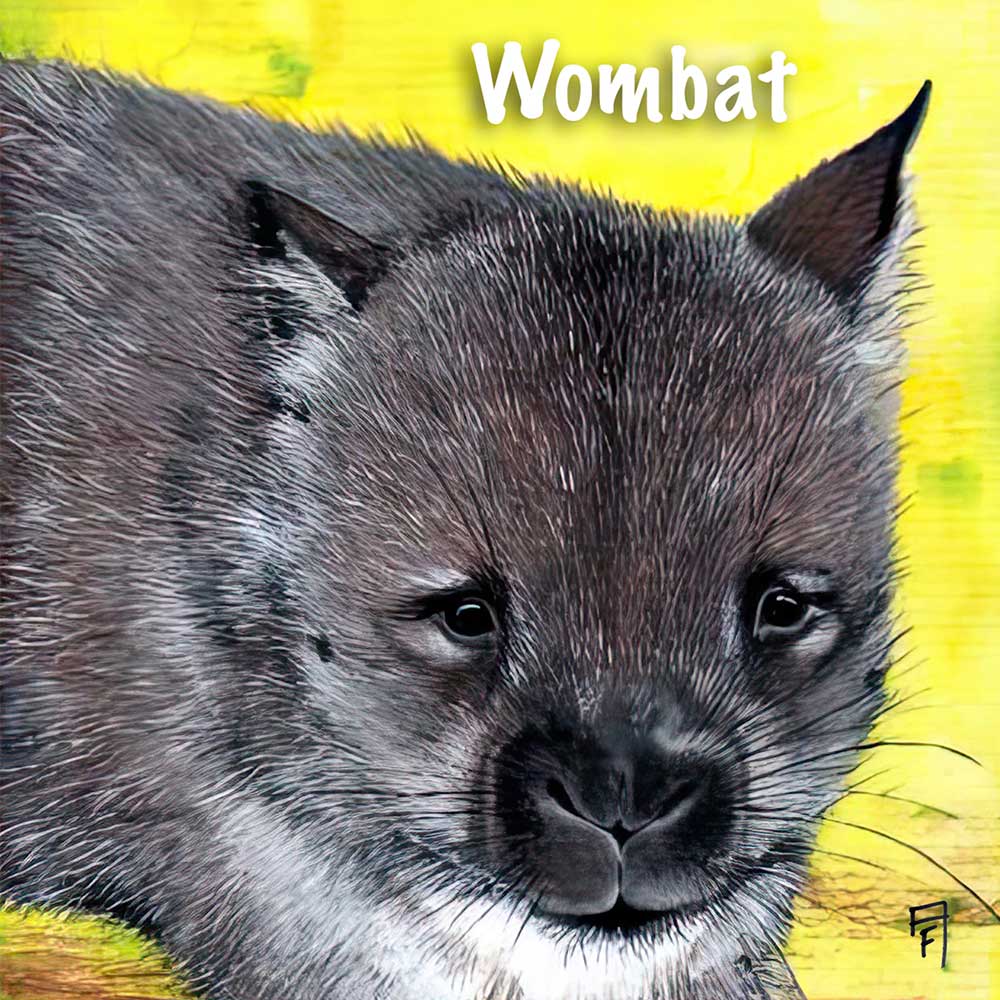
68x68mm Square full colour printed magnet. ‘WOMBAT’. 100% Tasmanian Made. (c) Annie Fitz – Art Magnet Range.
The bare-nosed wombat, also known as the common wombat, is the world’s largest burrowing herbivorous mammal. Indeed, it is such an accomplished burrower that early settlers called it a ‘badger’, a term that is still heard today. However, the closest relative of the wombat is, in fact, the koala. With its short tail and legs, characteristic waddle and ‘cuddly’ appearance, the wombat is one of the most endearing of Australia’s native animals. The bare-nosed wombat occurs in Tasmania, southern Queensland, eastern New South Wales and eastern Victoria with remnant populations in south-eastern South Australia and south-western Victoria. There are two other species of wombat, both found on mainland Australia – the southern hairy-nosed wombat and the threatened northern hairy-nosed wombat.
There are three subspecies of bare-nosed wombat (Vombatus ursinus hirsutus) which is found on the Australian mainland, the Tasmanian wombat, (Vombatus ursinus tasmaniensis), which is found in Tasmania and the Flinders Island wombat (Vombatus ursinus ursinus,) which was once found throughout the Bass Strait islands but is now restricted to Flinders Island, and was introduced to Maria Island. Wombats can be seen in a number of Tasmania’s national parks, including Mt William and Cradle Mountain National Park